Artificial intelligence (AI) is moving from assisting accountants with individual tasks to carrying out some accounting tasks itself.
For our profession, this means the central question is no longer, “what can it do?”.
Instead, we must now consider how AI can be safely delegated, who should take account for the tasks it carries out and how we will continue to develop professional judgement as a profession as machines do more of these tasks in the future.
Familiar uses for AI in accounting already include summarising a board paper, drafting a report or explaining a variance – but agentic AI goes a step further, by pursuing an objective across several connected steps.
Given an objective and defined boundaries, an AI agent can retrieve information, interact with systems, choose its next step and adjust its approach until the task at hand is complete, or human intervention is needed.
Whereas generative AI has acted largely as an assistant, agentic AI invites us to reconsider the actual process through which it undertakes and completes tasks.
Consider a finance function, for example. An AI agent preparing the first draft of monthly management accounts might retrieve data, compare actual results with budget, investigate an unusual movement and draft an explanation. From there, it might assemble the reporting pack for review. Work that might once have taken an accountant hours or even days to complete can now be completed in a much shorter timeframe. But, more than this, much of the process has been handled by the AI agent.
Accountants today may therefore spend more time overseeing work than performing it. In this context, the challenge becomes deciding what can be delegated safely, whether or not the result can be trusted and where human professional judgement is essential.
A longer-term question also arises: how will accountants develop professional judgement in the future if they no longer perform much of the work through which it has traditionally been learned?
Delegating the work, but not the responsibility
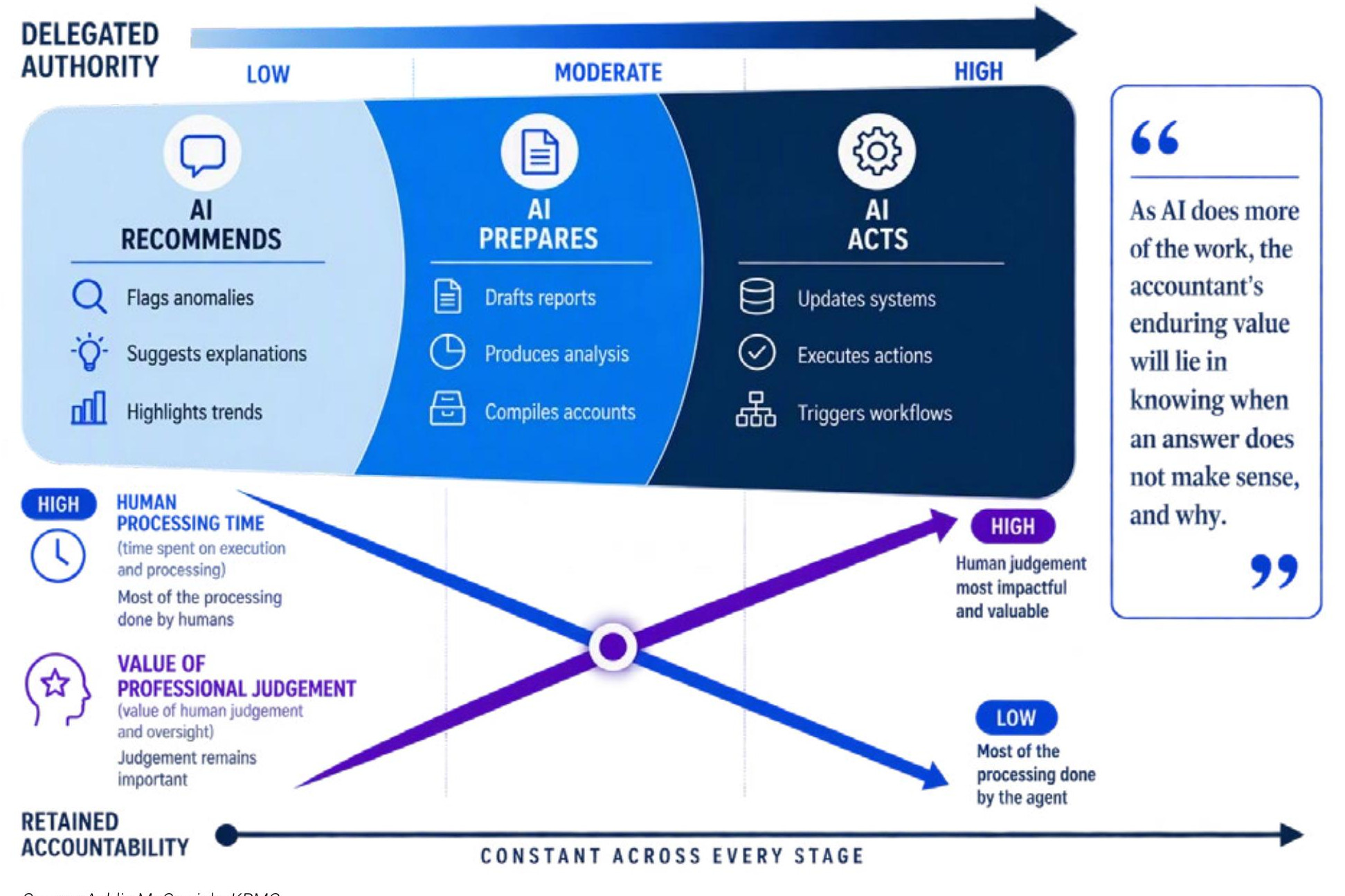
A useful way to think about agentic AI is through three broad levels of autonomy:
• AI advises: it recommends an action, which a person then takes.
• AI prepares: it completes the work, but a person approves the proposed action.
• AI executes: it acts within agreed limits without requiring approval at each step.
An AI system that drafts an email presents a different risk from one authorised to send it. Analysing a ledger is very different from changing it. Identifying a potentially duplicate payment is not the same as blocking or releasing this payment.
What an agent can do is clear to see. Deciding how much freedom to give it is harder to determine.
Consider an agent used within procurement. Allowing it to identify potential suppliers may present little risk. Allowing it to create supplier records, amend bank details or initiate payments is a different matter altogether.
As AI autonomy increases, the nature of human involvement also changes, with less time spent processing and greater value placed on professional judgement (seeFig. 1). As its authority expands, so do the consequences of any potential error.
None of these concerns are entirely new. The accounting profession has always thought in terms of risk, consequences and controls. In practice, an AI agent’s access would ideally be proportionate to its task, with appropriate approval for actions carrying serious or irreversible consequences.
Organisations would also benefit from retaining enough evidence to be able to reconstruct the agent’s actions, and their sequence – and, where necessary, reproduce the result through an independent human or alternative system-based procedure.
Delegating a task does not delegate responsibility for its outcome. A named process owner would ideally remain answerable for the agent’s authority, operation and output, supported by clear approval and escalation responsibilities.
Where an agent contributes to financial reporting, it is advisable that there is a record of its inputs, instructions, actions, decisions and human interventions that would make it possible to:
• explain why the system has acted as it has;
• identify who has approved significant steps; and
• correct errors, should they have occurred.
Organisations need to consider change. AI is not static software. Models evolve, instructions are updated, connected systems change and permissions are revised.
A process that behaved reliably three months ago may not behave identically today. Periodic reassessment of access, performance and controls would help management confirm that the process remains within its intended boundaries.
Mistakes will happen. The practical concern is the extent of any unintended impact that might occur before an error has been identified and addressed. Limiting what an agent can access and change may be more effective than trying to eliminate every possible error.
Understanding the process, not just the output
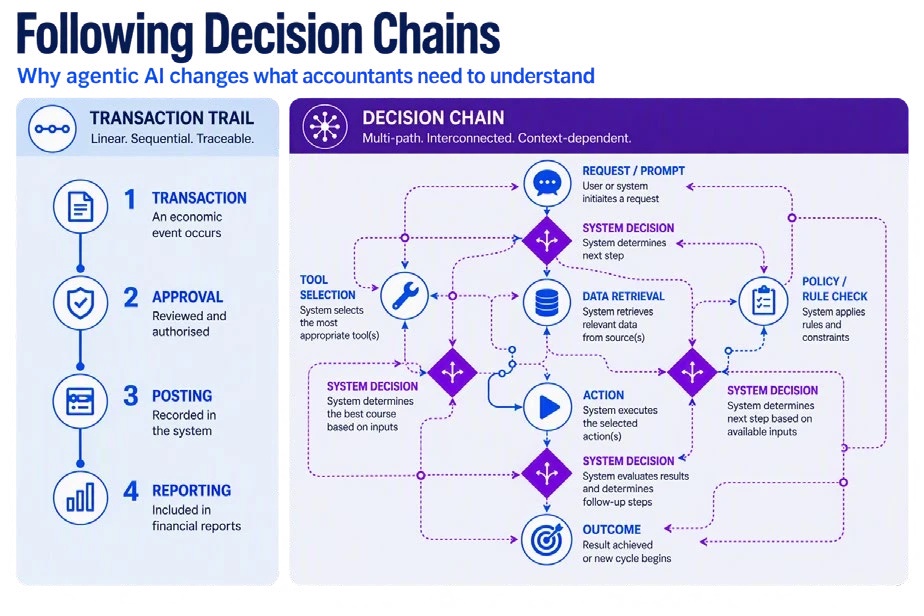
When an AI-enabled process contributes information to an organisation’s financial statements, reviewing the final output is unlikely to be enough.
Management and auditors need to understand the flow of information, the decisions made within the process and who remains accountable for the outcome.
Suppose an agent attributes an unexpected change in gross margin to higher input costs, for example. The explanation may sound reasonable and appear consistent with the underlying transactions.
However, a reviewer would still benefit from checking whether the agent:
• retrieved complete and appropriate information;
• applied sensible thresholds; and
• considered competing explanations, such as product mix, classification errors or an incomplete data feed.
Understanding the path to a conclusion may therefore matter just as much as the conclusion itself.
Plausibility is not evidence. This concern is reflected in the International Auditing and Assurance Standards Board’s August 2026 exposure drafts proposing revisions to ISA 330, ISA 500 and ISA 520.
These proposals respond to the increased use of technology, strengthen the evaluation of the relevance and reliability of information used as audit evidence and reinforce the importance of professional scepticism throughout the audit.
Ideally, management would understand an AI-enabled process before the auditor asks and be able to explain how information moves from its original source, through the interconnected decisions made within the agentic system and into the financial statements (See Fig. 2).
What happens to the learning hidden inside the work?
Agentic AI raises another question: “How will future accountants learn, if they are no longer doing as much of the work themselves?”
For generations, accountants developed professional judgement by doing the work itself. They reconciled accounts, investigated differences and examined unusual transactions, usually sitting alongside people who had done it before.
Along the way they encountered the question that matters most: “Does this actually make sense?”
The profession has spent years trying to remove repetitive work. Now that technology may finally be capable of doing so at scale, it is worth asking whether some of this supposedly low-value work was quietly serving a rather valuable purpose after all.
“MISTAKES WILL HAPPEN. THE PRACTICAL CONCERN IS THE EXTENT OF ANY UNINTENDED IMPACT THAT MIGHT OCCUR BEFORE AN ERROR HAS BEEN IDENTIFIED AND ADDRESSED”
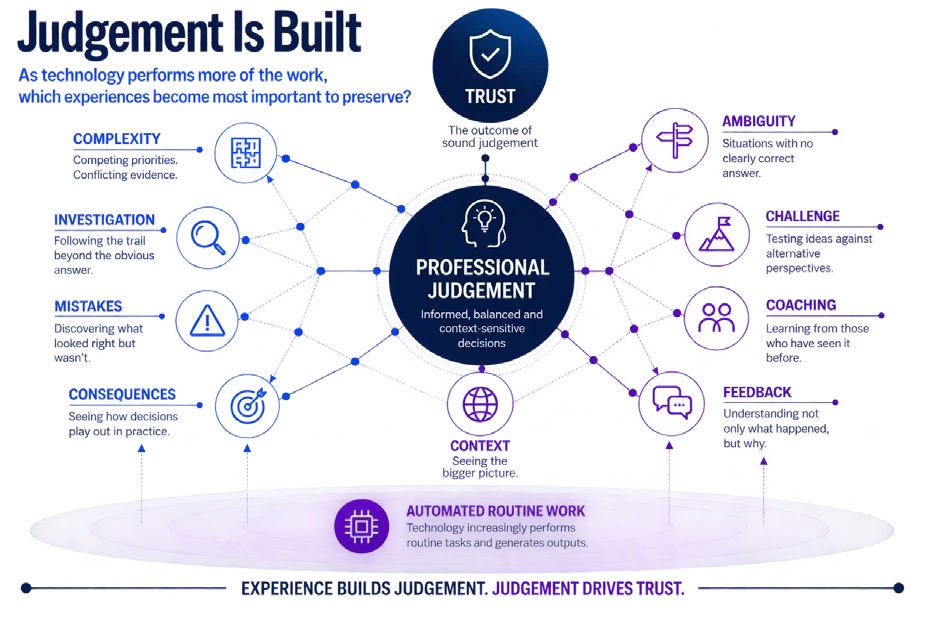
Nobody develops professional judgement from reading standards or attending training courses alone. It comes from experience (see Fig. 3). People encounter situations that do not fit neatly into a process manual and gradually learn which questions expose the real issue.
If AI now performs much of the work through which accountants historically developed this professional judgement, how will the next generation acquire it?
Keeping inefficient processes alive is not the answer. Few would argue that reconciling thousands of transactions is the best use of their time.
Imagine a scenario in which an agent prepares a reconciliation and identifies four exceptions, for example. A trainee could go beyond clearing them, examining why each was selected, testing an item the agent has ignored and assessing whether the threshold applied makes sense for the business.
Junior accountants would still need exposure to uncertainty, competing explanations and exceptions – and opportunities to exercise professional judgement. Ideally, they would be able to explain why an AI-generated conclusion has been accepted or rejected.
If junior accountants no longer experience the false starts and wrong turns through which judgement develops, it should not surprise us if this professional judgement takes longer to develop.
The accountant’s changing role
Not every accountant needs to become a data scientist or AI engineer to work with the technology. They would, however, benefit from understanding enough about AI-enabled processes to recognise where these processes work well, where they do not and how the quality of the information they produce affects the overall result.
Many professionals have spent their careers becoming better at performing work. Increasingly, the differentiating skill may be deciding what can be delegated to AI, and when a process should be returned to a person.
This requires professional judgement. So too does deciding which exceptions matter and how much evidence is enough before a conclusion can be accepted.
For finance leaders, the opportunity here is in looking beyond immediate efficiency gains and design automation to focus on clear accountability, proportionate controls and deliberate opportunities for people to develop professional judgement.
For those starting their careers, the priority is to learn how the business works, understand how information moves, investigate what the system did not select and challenge conclusions that appear entirely reasonable.
For experienced accountants, the role will increasingly centre on setting boundaries, supervising automated processes and recognising when a plausible answer lacks adequate support.
Technology can produce convincing answers quickly. The professional contribution is knowing when to pause, trace the evidence and assess whether the conclusion actually reflects the underlying business reality.
This professional judgement will matter more, not less, no matter how sophisticated agentic AI becomes. As artificial intelligence does more of the work, the accountant’s enduring value will lie in knowing when an answer does not make sense, and why.

Ashlin McGarrigle is Associate Director, Centre of Excellence Audit Technical, KPMG Ireland