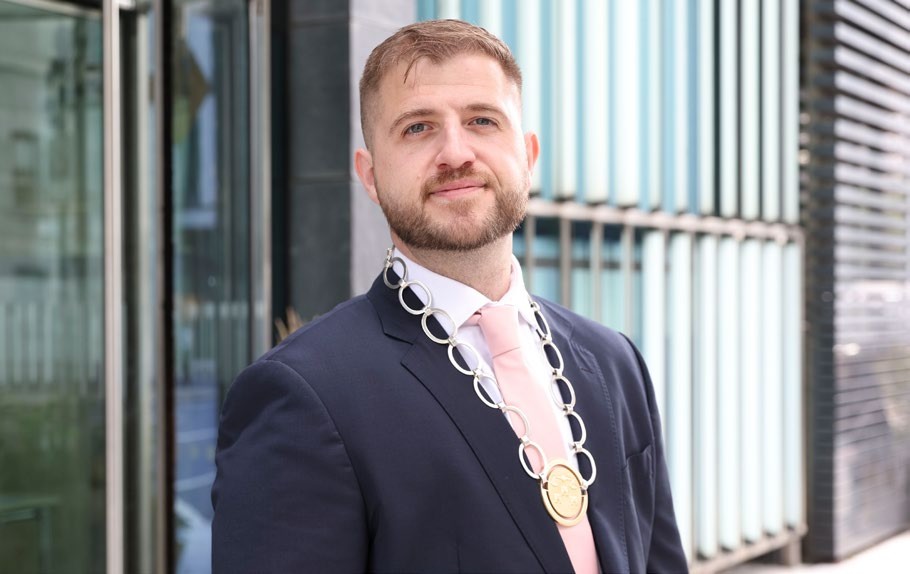
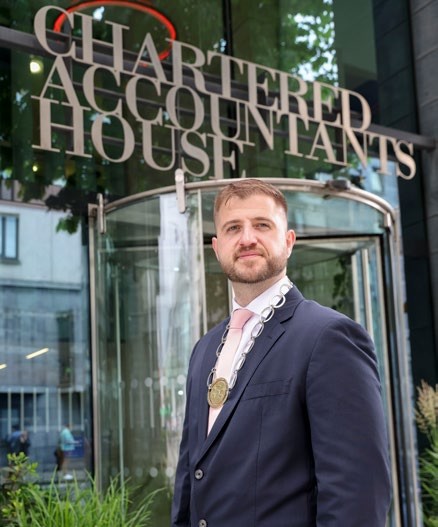
Darren Holmes is Group Accounting Director with EXA Infrastructure and Chair of the Chartered Accountants Ireland Leinster Society.
Holmes grew up in Terenure in Dublin and studied commerce at University College Dublin.
He qualified as a Chartered Accountant with BDO in 2020 and went on to work as Financial Controller with National Technologies, FKM Fit Out and Aqua Comms, before joining EXA Infrastructure in his current role in 2026.
Q Why did you decide to become a Chartered Accountant?
I started my career in banking initially, after travelling for a few years post-graduation.
As a Qualified Financial Adviser working in mortgage arrears, I had many difficult, and often very personal, conversations with customers.
I had always been interested in becoming a Chartered Accountant and left banking to join BDO at the age of 26 to begin my training – but those first few years of my career gave me invaluable experience in communication, empathy and dealing with challenging situations.
I am very proud of the path I’ve taken, particularly because it doesn’t represent the traditional route into the profession. It’s a good reminder that there is no single path to becoming a Chartered Accountant, and that your career doesn’t have to be mapped out from the beginning.
Q Tell us about your current role with EXA Infrastructure.
As Group Accounting Director, my role sits at the centre of the group’s financial reporting and accounting activities.
I work collaboratively across different functions and geographies. We have a finance team of more than 90 people in multiple locations, so good communication and teamwork is essential.
My responsibilities are varied, spanning financial reporting and ensuring we maintain high standards and that our accounting policies and processes remain compliant.
I work closely with teams across the business on accounting matters, supporting the financial aspects of major infrastructure projects and ensuring significant transactions and developments are appropriately reflected in the group’s reporting.
Q Among the people you have worked with over the years, who has inspired you most?
Three people in particular have had a big influence, each in different ways.
Stewart Dunne, a Partner with BDO, took a chance on me and gave me the opportunity to begin my career in practice. I will always be grateful to him for that.
What I admired most about Stewart was his ability to build strong and genuine relationships; it’s an important lesson I’ve carried with me.
Building a solid relationship creates trust, and this trust gives you the space to have difficult conversations when they’re needed.
Sandra Delany, now General Counsel with EXA Infrastructure, has also been hugely influential. She taught me the importance of backing myself, particularly when engaging with boards, investors and other senior stakeholders.
Sandra showed me how to stand firm in difficult situations while remaining professional and respectful. Developing the confidence to articulate and defend my views has been invaluable.
Another big influence in my career was Matt Mohan, owner and CEO of FKM Fit Out, where I worked as Financial Controller.
As an owner-manager, Matt demonstrated an impressive combination of commercial instinct, leadership and soft skills. I learned a great deal from his approach to business, building relationships and balancing the demands of running a company.
Q What are the values, standards and priorities that guide your career?
For me, professional values are less about having a list of principles on paper and more about how you conduct yourself every day.
Accountability is particularly important. If you take responsibility for something, you should own it, whether the outcome is positive or not. As you progress to more senior roles, people look to you not just for the right answer, but for the confidence that you will stand behind your decisions.
I believe strongly in being forward-looking. Accountancy is no longer just about reporting what has happened. Good finance professionals need to understand the business they work for, anticipate what is coming and ask the questions that will help that business prepare for the future.
Excellence is also important – maintaining high standards while remaining practical. I take pride in getting the detail right, but I also believe in continually learning and looking for ways to improve.
Finally, openness is crucial. Good relationships are built on approachability, honesty and willingness to listen. Some of the best decisions I’ve made have come from conversations with people who have a completely different perspective to my own.
Ultimately, while technical ability is important, successful and sustainable careers are built on trust, accountability and how you treat people.
Q What does your role as Chair of the Chartered Accountants Ireland Leinster Society mean to you?
Being elected Chair of the Chartered Accountants Ireland Leinster Society in June was a huge honour for me, both personally and professionally.
It is a role I am very proud to have, particularly because of the opportunity it gives me to represent and advocate for our members.
I really value the breadth of our membership. We have members at every stage of their career, working across many different sectors, and there is a great sense of community within the profession.
For me, the role is also an important opportunity to give something back. I have benefited enormously from the people I have met, and the opportunities the profession has given me, throughout my career. Being able to contribute in some way in return is very meaningful.
Q The results of this year’s Chartered Accountants Leinster Society Salary Survey were published in September. Tell us about the findings.
The 2026 Chartered Accountants Leinster Society Salary Survey, in partnership with Barden, provides a really interesting picture of where the profession stands currently.
Close to 800 Chartered Accountants took part, giving us a very good sense of what is happening in the market.
One of the headline figures is that the average salary package is now €130,960. For newly qualified Chartered Accountants, the average remuneration package is €65,538, rising to €89,759 for those five years post-qualification.
For me, though, it is not just about the salary figures. The survey shows that there are really good opportunities for Chartered Accountants to progress, with 37 percent of respondents having moved into more senior roles in the last three years.
The survey also reflects how much the way we work has changed. Hybrid working is now very much part of the landscape, for example.
Artificial intelligence (AI) is another particularly interesting area: 53 percent of our salary survey respondents use AI in their day-to-day work.
Barden, the talent advisory and recruitment firm, has been a fantastic partner to the Leinster Society since we first started working together on the salary survey in 2018. As sponsor, they bring a huge amount of knowledge and insight into the employment market. It’s a relationship I value.
Q What do this year’s Leinster Salary Survey results tell us about the state-of-play in the professional accounting market today?
The survey shows that the accounting profession is in a really strong position, while also evolving quickly. There is strong demand for Chartered Accountants, but the role is becoming broader and more commercial.
Increasingly, finance professionals are expected to understand the wider business, communicate with different stakeholders, build relationships and contribute to important commercial decisions.
The technical knowledge is still the foundation, but it is what you do with that knowledge that really adds value.
The survey also highlights the breadth of opportunities available to Chartered Accountants.
You can build a career in practice, industry, financial services, technology, infrastructure and many other sectors. You can move between areas and continue to develop new skills, experience and areas of expertise throughout your career.
Q What is the best advice you can offer young accountants starting out in their career today?
Not all career paths are the same, and that is absolutely fine. When you’re starting out, it can be tempting to compare your own progress with your peers and feel that you need to follow a particular path.
I certainly didn’t follow a traditional route, and I think the experiences I had along the way have been hugely valuable.
Don’t be afraid to make mistakes. Mistakes are an important part of developing as a professional. What matters is that you learn from them.
Be curious. Ask questions, so you can understand “why” things are done rather than just “how” and take an interest in the wider business.
Build relationships. Your technical skills will get you a long way, but the relationships you build with colleagues, clients and other professionals are incredibly important.
Put your hand up for opportunities. If something comes along that might stretch you, don’t automatically assume you’re not ready. You will learn by doing.
Q How do you expect the accountant’s role to evolve in the years ahead?
I think the role of the Chartered Accountant will evolve significantly in the coming years, particularly as AI becomes a much more prominent part of how businesses operate.
I’m very positive about this change. AI has the potential to take away a lot of repetitive work, allowing accountants to spend more time on analysis, judgement, strategy and helping businesses make better decisions.
I don’t think technology changes the fundamental role of the Chartered Accountant. Trust is at the heart of everything we do. Chartered Accountants are trusted business leaders, and this is something we need to continue to embrace and build on.
As technology becomes more sophisticated, there will be an even greater need for people who can understand information, challenge it, put it into context and make sound judgements.
Businesses will always need someone they can sit down with and ask: “what does this actually mean for us, and what should we do about it?”
I also think our profession will continue to move beyond the traditional perception of an accountant focused primarily on reporting and compliance.
Those areas will remain fundamental, but Chartered Accountants today have an opportunity to be much more involved in leadership and strategic decision-making.
For the next generation, the opportunity lies in combining the technical strength of our qualification with strong leadership, communication and relationship-building skills.
Technology will continue to change, probably faster than any of us expect, but the need for trusted people to lead, advise and make decisions, will always be there.