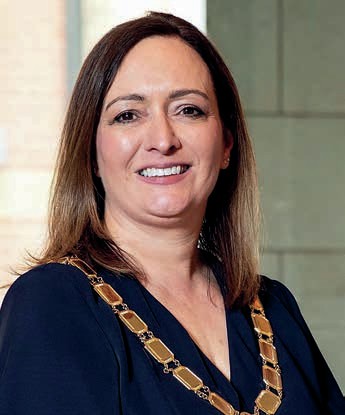
As this is my final article before our AGM in June, I want to express what an absolute honour it has been to serve as Chairperson of the Ulster Society. Representing our profession over the past year has been a real privilege, and my pride in being a Chartered Accountant has been further strengthened through the support and camaraderie of our members.
I hope you will join us at our AGM on 5 June at Custom House, Belfast, followed by our Summer Drinks. Before then, we have a wide range of events and initiatives still to come, so please do keep an eye on your emails and our social media channels for anything that might be of interest.
Since taking on this role, I have championed Northern Ireland’s economic potential. With unique access to both Great Britain and EU markets, strong transport links, and a stable business environment, our region is well-positioned for growth.
Leading global firms in data analytics, cybersecurity, life sciences, clean energy, and aerospace have already recognised this potential, and we must build on it.
However, challenges remain. A growing skills shortage threatens Northern Ireland’s economic progress. Our surveys highlight concerns that this issue is negatively impacting local firms and economic performance.
Over the past year, I have focused on the shortage of accountancy skills and the recruitment and retention challenges faced by businesses. Through our events and initiatives, we have showcased the power of the Chartered Accountancy qualification and its real-world impact. Chartered Accountants are not just number crunchers; they are problem-solvers, strategists, and difference-makers.
This edition includes results from our latest member survey, offering insights into the challenges and opportunities for our economy. Unsurprisingly, the outlook is tough – confidence in Northern Ireland’s prospects has halved in the past year, with only 8% of members viewing it as ‘good’ or ‘very good.’
Our region faces stagnation, rising costs, unpredictable politics, and a shortage of skilled workers. While dual market access presents opportunities, most members believe these have yet to be fully realised.
In response to the Executive’s Draft Programme for Government in November and the Budget Consultation in March, we advocated for long-term financial planning. The current budget is seen as a “standstill” approach, maintaining services without strategic future planning. A multi-year budget is needed to ensure stability and sustainable growth, alongside broader financial reforms to address emerging economic needs.
The budget relies on rate increases as its primary revenue-raising measure. We urge policymakers to explore alternative approaches, including serious consideration of a competitive corporation tax rate aligned with the Republic of Ireland’s 12.5%, which could attract investment and stimulate economic growth.
Additionally, we call for clearer targets, funding strategies, and policy commitments in the Programme for Government.
Our survey highlights three areas requiring urgent attention: health service reform, infrastructure investment, and the development of a globally competitive, sustainable economy that encourages private sector investment, innovation, and job creation.
While our members are candid about the challenges, they are equally clear about the opportunities.
Key strengths include dual market access, an educated workforce, proximity to major economic hubs, a lower cost base than our neighbours, world-class tourism and renewable resources, a strong work ethic, strategic geography for global trade, a high quality of life, and a culture of innovation.
This provides a solid foundation for progress. However, deep structural reforms are needed, including better governance, a clear and costed transformation plan, government-business collaboration, investment in skills, and policies that enable long-term growth.
With the right support, we can shift towards a long-term strategy focused on building a stronger, more competitive economy that benefits everyone in Northern Ireland.
As my term comes towards an end, I sincerely thank our members and member firms for their support. I am also deeply grateful to the Officer Group, to the many members who contribute to our committee structures, and to the Ulster Society staff.
It has been a pleasure to work with you all, and I extend my best wishes and full support to my successor for a successful year ahead.
Thank you.