Accounting for a better tomorrow
Garry Carnegie and Louise Gorman make the case for a multidimensional definition of accounting that can shape a better future in which organisations, people and nature flourish

How do you define “accounting”? How do you view and explain your role as enabler of positive change in world betterment?
Traditional definitions of accounting, arguably, misrepresent the discipline. They understate the importance of the profession, lacking a clear focus on accounting’s social and moral dimensions.
Defining “accounting” in 2026
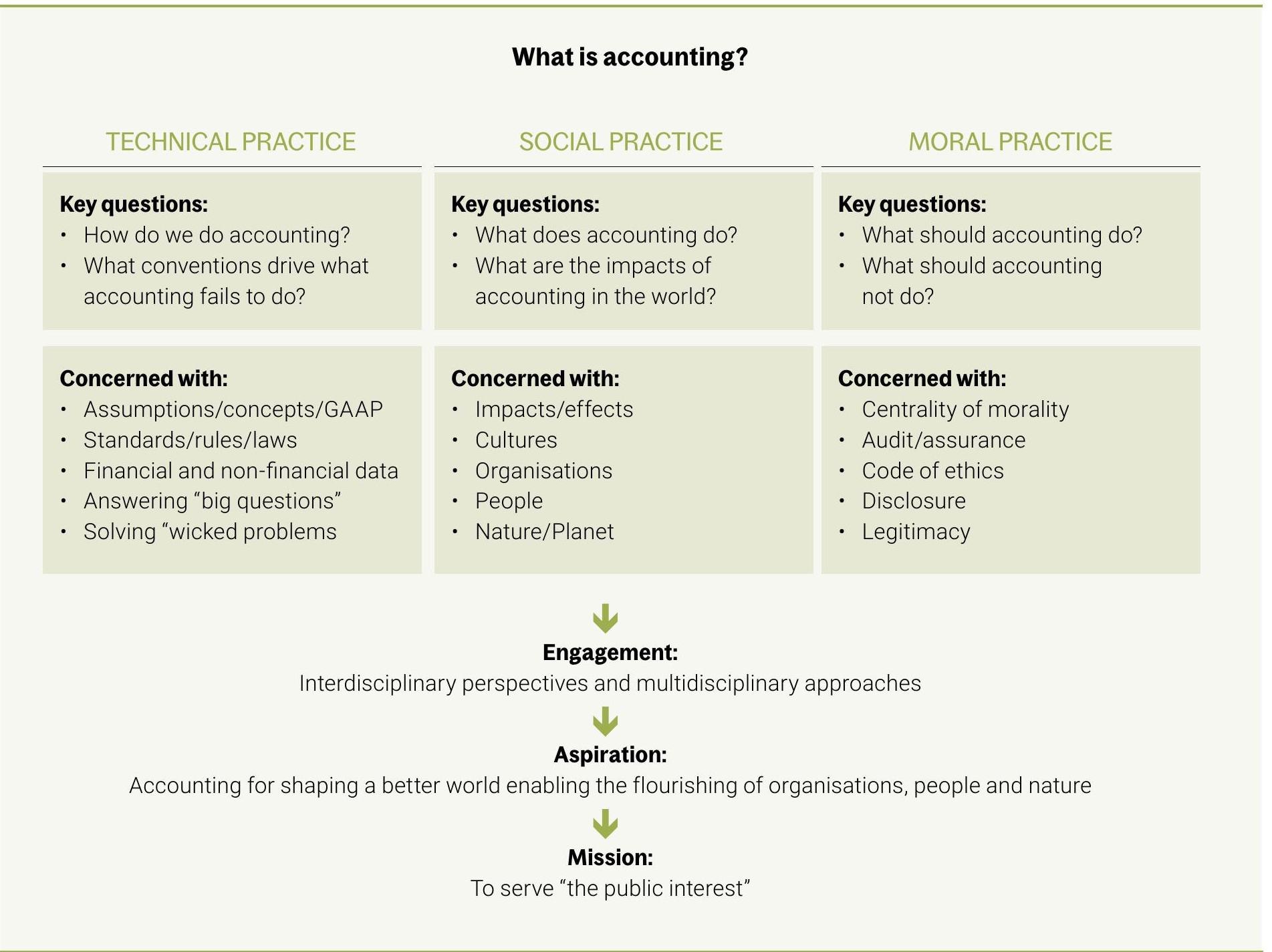
In 2021, Carnegie, Parker and Tsahuridu proposed a definition of accounting as a multidimensional: “technical, social and moral practice concerned with the sustainable utilisation of resources and proper accountability to stakeholders to enable the flourishing of organisations, people and nature”.
This definition addresses the following key questions:
• Technical practice: How do we do accounting? What conventions drive what accounting fails to do?
• Social practice: What does accounting do? What are the impacts of accounting in the world?
• Moral practice: What should accounting do? What should accounting not do?
Accounting is a practice of technical rigour, social responsibility and moral means and purpose. It is not merely a neutral, benign, technical practice.
Accounting as multidimensional practice
The technicist dimension, or the traditional definition of accounting, is broadly known in the profession. It largely involves the application of accounting concepts and techniques in producing financial reports and other intended decision-useful accounting information.
As a social practice, accounting shapes our behaviour, as exhibited in organisations, societies and the natural environment. For instance, key performance indicators (KPIs) set within an organisation – based on accounting information – strongly influence behaviour within that organisation.
As such, accounting is a powerful practice that has the potential to change behaviour for the betterment of organisations, people and nature. Yet, this dimension captures less coverage, if any, in typically taught and applied definitions of accounting.
From a moral perspective, accounting is a practice whose actions and inactions influence others, both now and in the future, and helps to shape the moral order of organisations and society.
Fundamentally, it is a question of what is understood as right and what is wrong for organisations, societies and our natural environment.
The moral dimension is concerned with ensuring that accounting for stakeholders can always be trusted by the public “to serve ‘the public interest’”. This fundamental role and expectation should never be taken for granted.
Viewed from these multiple dimensions, one might see how accounting is not merely “the language of business”, which itself is narrowing.
It has multiple languages. It can extend well beyond business and organisations, to be used as a means of addressing contemporary societal and natural environmental challenges. It can shape, and create conditions for, a more equitable and sustainable world, especially a less threatened one for future generations.
Currently, it appears that our younger colleagues, clients, students, children and grandchildren will not enjoy the
abundance of natural and social resources we depend upon today.
A sole or heavily concentrated focus on accounting as a technical practice alone does not place the accountant in a position of moral influence or moral responsibility to preserve these resources.
Indeed, the emphasis many modern sustainability reporting frameworks place on technical measurement and KPIs can deter, rather than inspire, effective thought and suitable actions to help facilitate the flourishing of organisations, people and nature.
Truly serving the public interest
Most of our roles lead us to focus on monetary value in one way or another, especially upon the qualitative characteristic of reliable measurement.
We miss opportunities to reflect upon the worldwide impacts resulting from quantification in financial terms.
How often do we stop to consider the immeasurable value, vital importance and unique interconnected
systems in nature which support business continuity and continuous human life?
Ecologically informed, natural environment-orientated management accounting systems for decision-making are particularly conductive to nature conservation and restoration, thereby truly serving the public interest.
Adopting and implementing a broader-scope definition of accounting requires an assessment of what the contemporary public requires from accounting in terms of its nature, roles, uses and impacts throughout organisations, societies and the natural environment.
We must examine and assess how practitioners, educators and other parties involved in professional accountancy can shape a better, more sustainable and equitable, world.
Acting in the public interest requires an acceptance of all three elements included in the multidimensional definition of accounting. The related “Public Interest Framework for Multidimensional Accounting” presented in our graphic portrays the public interest mission of accounting as the essential means for proper global accountability to stakeholders.
This is a means of transitioning to a more all-encompassing view of the public interest to be served by accounting and accountants.
The objective of the framework is not to move away from the presently accepted definition of “public interest” as depicted in the International Federation of Accountant’s (IFAC) Policy Position Statement, No. 5, which presents a practical definition identifying the public interest, and enables one to assess the extent to which actions, decisions or policies are made in the public interest.
This definition avoids taking a business or financial orientation. Indeed, the public acutely depends on resources that:
• Do not directly stem from the business operations of reporting entities; and
• Possess intrinsic non-financial values for society on which we depend for our existence and sustenance into the future.
Accounting: non-financial value
A broadening of how we view and deploy accounting moves beyond considering value as being expressly of a monetary, and even calculative, form. It is perhaps instinctive that we financially value (and audit) objects of all kinds, irrespective of whether they are widely regarded as “priceless”.
Society generally has become conditioned to rely on quantitative financial values and related metrics of performance.
While KPIs and other metrics have their role, not everything valuable in our lives and futures can be measured reliably in financial terms. Non-financial reporting, however, remains underdone, when monetary values are of supreme importance in setting accounting standards.
“WE HOPE THAT OUR CALL TO CONSIDER ALL THREE DIMENSIONS OF ACCOUNTING MAY ENCOURAGE READERS, EVEN IF INITIALLY IN A MODEST WAY, TO MOVE ACCOUNTING’S CAPABILITIES AND INFLUENCE TOWARDS CREATING A BETTER WORLD FOR TOMORROW” – GARRY CARNEGIE
Non-financial, non-quantitative recognition of value is likely to be a key aspect of the future accountant’s role, particularly as artificial intelligence can, potentially as it seems, match our human ability to measure and calculate. The United Nations Sustainable Development Goals (SDGs) provides one, likely familiar, framework that moves beyond measurement toward essential actions which must be taken to maximise the potential of people and planet alongside profit.
SDG 9, for instance, focuses on infrastructure including housing and hospitals – issues typically debated in monetary terms. Yet, it is impossible and inappropriate to place a monetary value on the human lives reliant upon such infrastructure.
This then begs the question as to why so much wealth is directed towards infrastructures that do not fully support, and even harm, human and non-human species.
Recent energy- and weather-related disruptions to organisational and social functioning have exacerbated problems of hunger to varying extents across the world. This is despite the intent of SDG 2 to eliminate hunger, SDG 7 to develop clean and affordable energy and SDG 13 to tackle climate change.
While we are exposed to frequent news of such problems, we may be remiss to think of the natural environment as our ultimate controller and service provider.
Recognition of this is a vital step in devising appropriate mechanisms of accounting, accountability and governance “to enable the flourishing of organisations, people and nature”, and to foster and support sustainable business.
An interdisciplinary approach
More engagement with society and the natural environment in our work may appear to be a somewhat idealistic, aspirational and abstract proposition. Making this a reality invariably requires interdisciplinary collaboration.
Despite living in a globally connected world, it remains only too easy to remain in our own fields of experience.
As we become more aware of the wicked problems of global warming, pandemics and poverty – to mention just a few examples – we have come to learn more from, and reflect broadly upon, the work of scientists, environmentalists, healthcare professionals and humanitarians, to name but a few areas of expertise.

In our own area of accounting academia, we have been slow to truly engage with other disciplines. For instance, a recent study by Sophia Ji at RMIT University shows that most scholarly research applying accounting related concepts to sustainable development is conducted by non-accounting researchers.
Beyond research, we must not underestimate the importance of engaging business students with peers in the natural and other social sciences.
IFAC’s revised International Education Standards and Chartered Accountants Ireland’s Project Athena set out to provide the basis for preparing future generations of “systems thinkers” to enter the profession.
Thus, educators must act now to lay the foundations for a broader definition of, and approach to, accounting for the common good as aptly endorsed by Sheila Killian and Philip O’Regan from the University of Limerick.
Accounting for a better world
Increasingly, the world looks to accounting as a means of valuing priceless and irreplaceable resources that come from the natural environment and a good quality of life.
It appears timely to ask if we, as professionals and academics, have innovated sufficiently to ensure these precious resources are properly accounted for in their specific contexts, and governance exists to ensure that they are sustained for, and perhaps better utilised by, future generations.
We hope that our call to consider all three dimensions of accounting may encourage readers, even if initially in a modest way, to move accounting’s capabilities and influence towards creating a better world for tomorrow.
What reason is there to oppose aspiring to ensure that accounting steps up to shape a better world, to enable “the flourishing of organisations, people and nature”?


Garry Carnegie, FCA, is Emeritus Professor of RMIT University, Melbourne. He is a fellow of CPA Australia and a member of Chartered Accountants Australia and New Zealand Louise Gorman is an Assistant Professor at Trinity Business School, lecturing and researching in the areas of accounting, finance, corporate governance and environmental, social and governance