Pillar Two overview
In this article, Harry Harrison, Paul McKenna, and Alma de Bruijn from PwC provide an overview of the Pillar Two rules in Ireland.
Introduction
The Pillar Two Global Anti-Base Erosion (GloBE) rules were implemented into the Irish Taxes Consolidation Act 1997 via Part 4A of the Finance (No. 2) Act 2023.[1] The GloBE rules represent a fundamental change to how international profits of large multinational and domestic groups are taxed. This article provides an overview of the GloBE rules as enacted in Ireland by Finance (No.2) Act 2023, and as subsequently updated through later Finance Acts and OECD administrative guidance.
Background and Road to Implementation
The GloBE rules aim to ensure that large corporate groups pay a minimum effective tax rate (ETR) of 15% on profits arising in each jurisdiction in which they operate, with a top up tax applying where that rate is not met.
The rules were developed by the OECD Inclusive Framework and adopted by more than 140 jurisdictions. These rules are generally referred to as the OECD Model Rules.[2] Shortly after the OECD Model Rules were published, the European Commission published the EU Minimum Taxation Directive, which provided a basis for the EU Member States to apply the OECD Model Rules with some modifications to ensure compatibility with EU law.[3]
The OECD has issued administrative guidance to clarify and supplement the GloBE rules, including temporary and permanent safe harbours, with ongoing guidance as the framework evolves.
The Irish rules align with the EU Directive and incorporate applicable OECD administrative guidance through section 111B TCA 1997, under which subsequent OECD guidance is given effect in Irish law.
The rules apply to accounting periods commencing on or after 31 December 2023, with certain elements (notably the Undertaxed Profits Rule) deferred for some groups. This is by reference to the accounting period for which the ultimate parent entity (UPE) of the group prepares consolidated financial statements.
Scope of the GloBE Rules: s111C
The rules apply to groups (both multinational and large-scale domestic groups) whose annual revenue was €750m or more in the UPE’s consolidated financial statements in at least two of the four fiscal years immediately before the tested fiscal year (the tested fiscal year being the first period in which the group is in scope of the GloBE rules). Groups meeting this threshold are referred to as “in-scope groups” for the purposes of this article.
If a constituent entity (CE) forms part of an in-scope group, then it will be subject to the GloBE rules. Whether a CE is part of an in-scope group will depend on whether the entity has been treated as a consolidated entity in the UPE’s consolidated financial statements for that period.
Certain CEs are treated as “excluded entities” and, while their revenues count toward the €750 million threshold, the GloBE rules do not apply to them. For GloBE rules, a governmental entity, a non-profit organisation, a pension fund or an investment fund that is a UPE are all examples of excluded entities.
GloBE Income: ss111O–111S
The GloBE rules require taxpayers to compute a specific tax base, using the accounting profits from the consolidated financial statements as a basis which are subject to specific adjustments, which will result in a GloBE “income or loss amount” calculated on a jurisdictional basis.
Typically, GloBE income or loss is calculated using data from the UPEs consolidated financial statements. [4] In certain circumstances, it will be necessary to use the CEs statutory financial statements prepared under the local accounting standard. This applies where the qualified domestic top-up tax (QDTT) is the collection mechanism for any top-up tax in respect of Irish CEs.
The starting point for calculating the GloBE income or loss is the profit after tax taken from the relevant set of financial accounts (known as the financial accounting net income or loss, or FANIL). A number of specific adjustments are made to the FANIL to arrive at GloBE income or loss.
Below is a high-level overview of the various adjustments required and the relevant section of the legislation to which it relates.
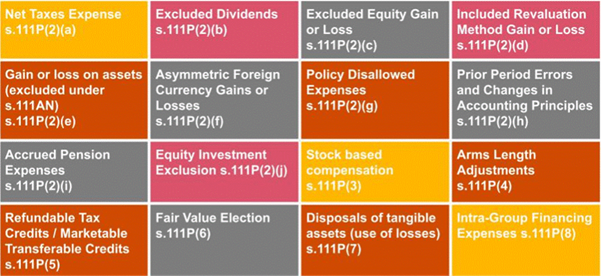
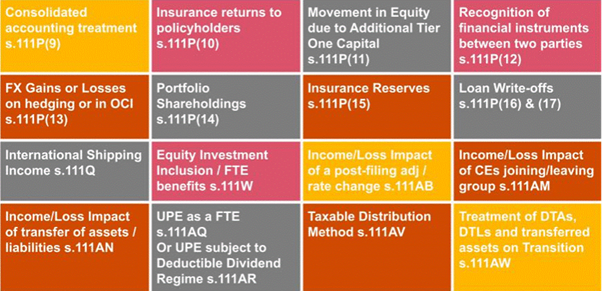
There are also rules set out in ss111R and 111S regarding the allocation of income and losses.
Adjusted Covered Taxes: ss111T–111AB
In-scope groups will also need to compute “adjusted covered tax” amounts, which are divided by the GloBE income or loss to determine the jurisdictional ETR. This rate determines whether the minimum effective tax rate of 15% has been met.
The adjusted covered tax amount comprises both current and deferred taxes, based on the tax amount reflected in the financial statements but subject to specific adjustments.
In certain cases, the amount of a deferred tax attribute will need to be recast for GloBE purposes from the rate at which the attribute is carried in the financial statements to a deferred tax asset or liability based on a rate of 15%
Calculating the Top-up Tax: ss111AC–111AD and 111AF
The following steps are required to determine any top-up tax amount. As noted above, these steps need to be performed on a jurisdictional basis, unless there is only one CE in a jurisdiction, in which case an entity-level approach can be adopted.
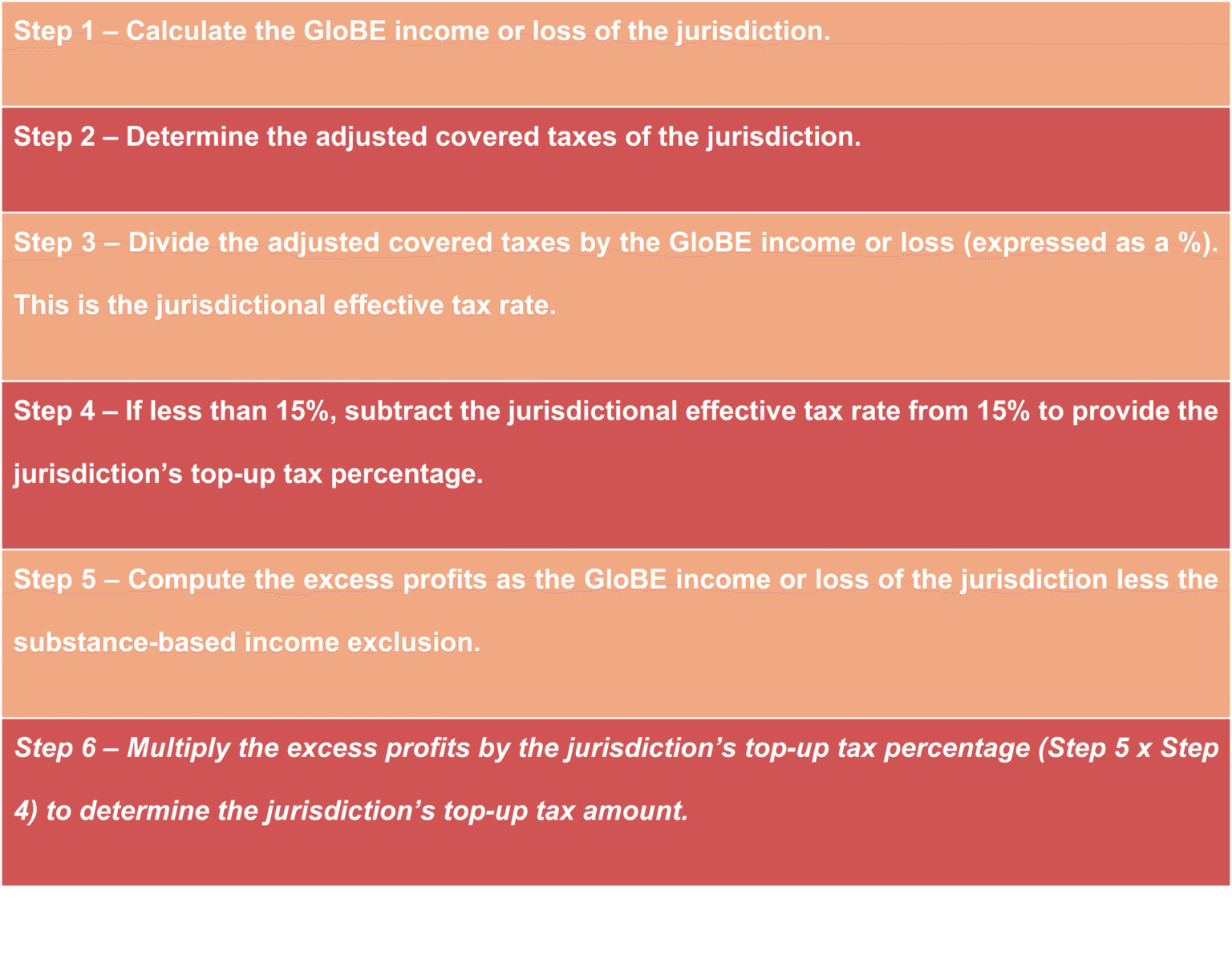
Substance-Based Income Exclusion (Substance Carve-out): s111AE
The substance‑based income exclusion recognises that groups with substantive operations in a jurisdiction should be subject to a reduced Pillar Two exposure in that jurisdiction. It operates by deducting a carve‑out amount from excess profits before applying the jurisdictional top‑up tax percentage, thereby reducing any top‑up tax liability. The exclusion is calculated as a percentage of eligible payroll costs and the net book value of tangible assets located in a jurisdiction. The payroll carve‑out starts at 10% (reducing to 5% by 2034), while the tangible asset carve‑out starts at 8% (also reducing to 5% by 2034). The combined amount is treated as the substance‑based income exclusion.
Collection Mechanisms: ss111E–111N, 111AAA–111AAE
The top-up tax liability is collected through three different mechanisms: the qualified domestic top-up tax (QDTT), the income inclusion rule (IIR) and the undertaxed profits rule (UTPR).
The GloBE rules allow countries to introduce a QDTT based on the GloBE mechanics into their own domestic law. Where a QDTT is introduced, it ensures that a jurisdiction has the primary right of taxation over its own income.
If the jurisdiction where the low-taxed CE is located does not introduce a QDTT, then any top-up tax should be collected through the IIR. Under the IIR, the top-up tax is paid at the level of the parent entity, in proportion to its ownership interests in those entities for which the top-up tax has arisen. Generally, the IIR is applied at the level of the UPE, but it may apply further down the ownership chain (collected by an intermediate parent entity) if the UPE is not subject to an IIR.
A backstop rule, the UTPR allows the top-up tax to be collected by another entity in the group if top-up tax would not be collected in any jurisdiction under the QDTT or IIR rule. This could be the case where the various jurisdictions represented through the ownership chain have not implemented the IIR.
Ireland has introduced these three collection mechanisms in Finance (No.2) Act 2023; however, the UTPR will in most cases apply only from 1 January 2025.
Transitional CbCR Safe Harbour: s111AJ
Finance (No. 2) Act 2023 introduced the transitional CbCR (country-by-country reporting) safe harbour to reduce the complexity of performing detailed calculations and meeting burdensome compliance obligations under the GloBE rules for low-risk jurisdictions in the first three years of implementation.
The safe harbour reduces an in-scope group’s top-up tax for a particular jurisdiction to zero where one of three criteria is met:
- De minimis test: CbCR revenue is below €10million and the CbCR profit (or loss) before tax is less than €1million.
- Simplified ETR test: simplified ETR meets or exceeds the applicable transition rate (15%, increasing to 16% for FY2025 and 17% for FY2026), calculated as simplified covered taxes divided by CbCR profit (loss) before tax.
- Routine profits test: CbCR profit (or loss) before tax does not exceed the substance‑based income exclusion calculated under the GloBE rules.
To rely on the safe harbour, groups must prepare a qualified CbC report in accordance with OECD guidance.
The transitional CbCR safe harbour is a temporary measure and has been extended to cover fiscal years beginning on or before 31 December 2027 but not including a fiscal year ending after June 2029. [5] As this transitional relief phases out, it will be followed by the new Simplified ETR Safe Harbour, which applies in later fiscal years and provides a more permanent simplification by allowing groups to demonstrate that no top‑up tax is due in a jurisdiction using simplified, financial‑accounting‑based calculations with limited Globe adjustments instead of full GloBE computations.
Transition Rules: ss111AW–111AY
The transition rules in ss111AW–111AY govern the treatment of deferred tax attributes and asset transfers on entry into the GloBE regime, with existing deferred tax attributes, including those arising from pre‑transition losses, taken into account in calculating the effective tax rate.
The rules also restrict the uplift of asset values through intra‑group transfers occurring during the transition period. Assets transferred between constituent entities during this period must be recorded at historical carrying value for GloBE purposes, with any related deferred tax expense calculated by reference to that value. These GloBE‑specific adjustments do not affect the accounting balance sheet.
An exclusion from the IIR and UTPR applies to MNE and large‑scale domestic groups in the first five years of their initial international activity, where the group operates in no more than six jurisdictions and holds tangible assets outside the reference jurisdiction with a net book value not exceeding €50m, although the exclusion may not apply to all entities
Compliance and Administration: ss111AAF–111AAAD
The deadline for registering a CE for Pillar Two taxes in Ireland is within 12-months of the end of the relevant fiscal year. Registration is a one-time process and does not need to be repeated annually. A failure to comply with the registration requirement may give rise to a fixed penalty of €10,000.
Under Irish Pillar Two legislation, each Irish CE will be required to file GloBE returns (i.e., QDTT, IIR) within 15 months of the end of the accounting period of the UPE who prepares the consolidated financial statements. There is an extended deadline of 18 months for the first period the CEs come within scope of the rules. Please note top-up tax is due on the same date.
The Irish CEs can elect to join a QDTT group and nominate a QDTT group filer to submit the QDTT return on behalf of all Irish CEs.
Each entity will need to file a GloBE Information Return (GIR) within 15 months of the end of the relevant year. Alternatively, if another entity has been designated to file on its behalf, it needs to file a notification of filer by this date.
DAC 9 – Standardised reporting and information exchange
The Finance Act 2025 transposes DAC 9, the EU’s ninth amendment to the Directive on Administrative Cooperation, into Irish law. DAC 9 establishes a mandatory, standardised Top‑up Tax Information Return (TIR) to be used by in‑scope groups filing within the EU, aligned with the OECD GloBE Information Return for filings made outside the EU. It allows groups to file a single TIR in one EU Member State, rather than multiple local filings, and provides for the automatic exchange of that information between EU tax authorities. Where the TIR is filed outside the EU, information exchange will instead take place under the OECD Multilateral Competent Authority Agreement (MCAA) on the Exchange of GloBE Information.
Conclusion
Complying with the GloBE rules remains challenging for in‑scope groups, requiring a clear understanding of the rules, access to detailed data and effective integration into day‑to‑day tax and finance processes. The rules apply from 1 January 2024 and represent a significant departure from existing Irish corporate tax law, meaning transactions must now be assessed through a Pillar Two lens.
Harry Harrison is an International Tax Partner at PwC Ireland; Paul McKenna is an International Tax Director at PwC Ireland; and, Alma de Bruijn is an International Tax Director at PwC Ireland.
[1] Finance (No. 2) Act 2023, available via this link.
[2] OECD, Tax Challenges Arising from the Digitalisation of the Economy – Global Anti-Base Erosion Model Rules (Pillar Two) (Paris: OECD Publishing, 2021), available via this link.
[3] Council Directive (EU) 2022/2523 of 14 December 2022 on ensuring a global minimum level of taxation for multinational enterprise groups and large-scale domestic groups in the Union, available via this link.
[4]PwC Ireland, Finance Act 2025, available via this link
[5] OECD Pillars. Transitional CbCR safe harbour. Available here.