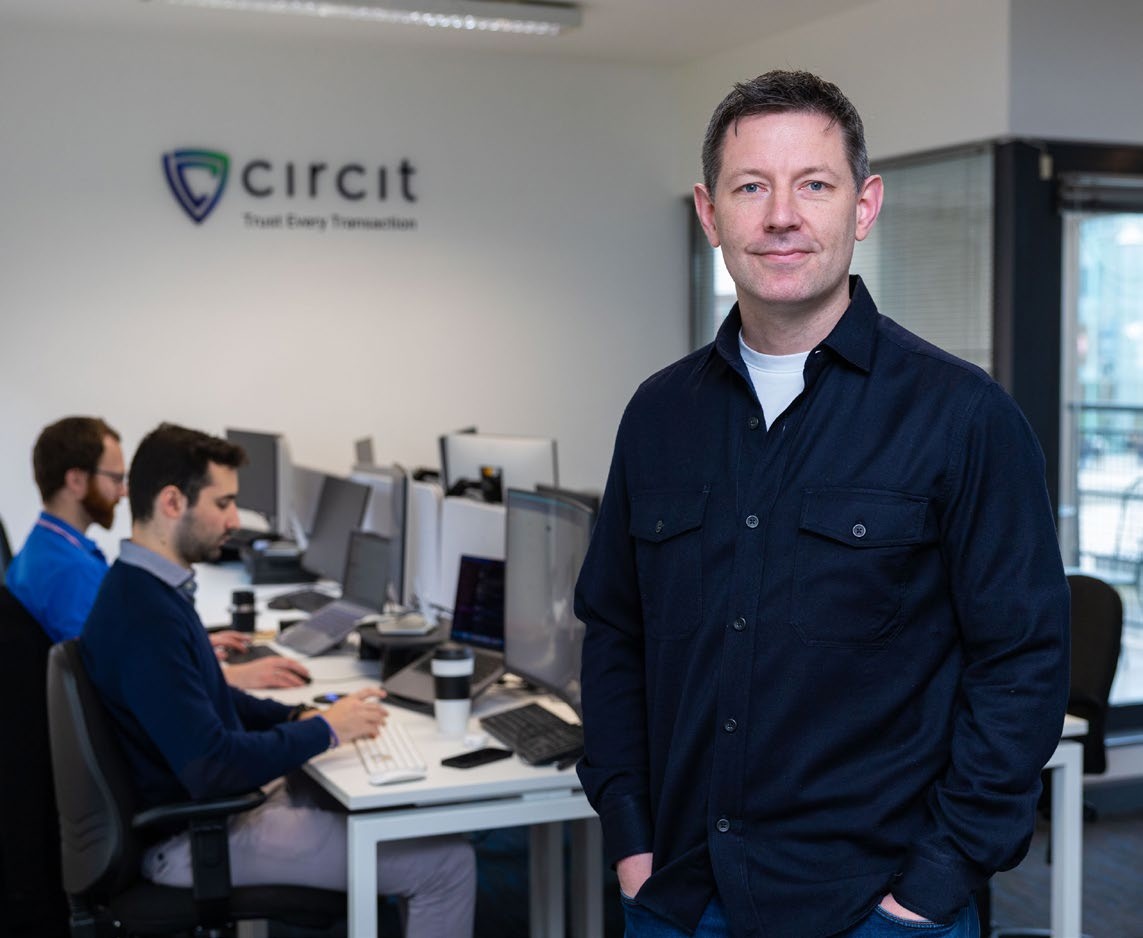
“It’s important to focus on solving problems rather than big ideas”
Circit founder David Heath shares his business story, inspired by his training in audit, and path to raising $22m in growth equity ahead of plans for global expansion

For David Heath, the path to business success as the founder of an Irish fintech firm on the cusp of global expansion hasn’t always been easy. Heath founded Circit in 2017 to develop an audit confirmation and financial data verification platform that netted the company $22 million in growth equity funding earlier this year.
When he started the company nine years ago, however, Heath had close to no backing and a third child on the way. It was a “scary time”, he says, but he persevered—driven by a burning desire to run his own business—and is now at the helm of an Irish success story preparing to scale globally. So far, the Circit platform has been adopted by more than 400 audit firms worldwide, establishing a verification network spanning some 30,000 banks, funds service providers and other evidence providers.
In the past year alone, Circit has facilitated the confirmation of assets and liabilities for 150,000 corporate entities, independently verifying an average of over 100 million transactions for each.
The company’s growth today is being driven by accelerating demand from large corporates for access to artificial intelligence (AI)-enabled, real-time and verified financial data, Heath says, but the Circit story effectively began in his childhood.
Early entrepreneurial drive
“My Dad had his own company and running my own business was always a dream for me,” Heath recalls. “Entrepreneurship was always on my mind, right up to my college years and beyond”.
Heath graduated from University College Dublin in 2007 with a degree in business, but starting his own business at that stage wasn’t a practical option. “My first child was on the way when I was leaving university,” he explains.
One of those sliding door moments came when a friend working in practice at the time advised him to consider getting into audit.
“I would have the benefit of working with a different business every two weeks, he told me, and that turned out to be very good advice”.
Heath trained with Grant Thornton, qualifying as a Chartered Accountant in 2010. The experience gave him crucial insight into different types of businesses, and how they are run.
There were also some downsides to his audit experience, however—chiefly in the confirmation realm. “I remember thinking at the time, ‘I didn’t spend three years at college to chase paper letters and type out reports using shoeboxes full of bank statements’”, he says.
These challenges would ultimately form the basis for Circit, as Heath became increasingly aware of the need to solve everyday problems faced by auditors. “It became clear to me that the confirmation problem was fundamental to audit,” he says. Just how the solution to this problem would inspire his own business was not yet clear, however.
“I left Grant Thorton in 2011 with a partner and worked in consulting for his firm three or four days a month. At the same time, I joined a tech start-up as head of finance and operations”, Heath says.
“As the only accountant in a company selling to accountants, I gained hugely valuable experience in product management and an understanding of the power of problem-solving. I gained a new skillset, effectively”.
During this period, Heath also completed a Higher Diploma in Web Engineering at the National College of Ireland (NCI).
“The NCI course was the bridge between my business and accounting skills and the more technical side of a business. I couldn’t build a product if I wanted to—auditing doesn’t grow those skills, so it was back to learning; learning how to code and so on”, he says.
Developing the product
The next milestone in Heath’s start-up journey came when he heard about the Ulster Bank Hackathon, a now-defunct annual event run in partnership with the Dogpatch Labs incubator in Dublin, which brought together coders, designers and entrepreneurs to develop working prototypes for fintech products.

“I knew I wanted to solve the confirmation problem I had discovered during my time in audit, so I pitched the idea to some Ulster Bank executives. They asked me to bring my idea to the hackathon and that experience gave me the confidence to turn my idea into something real”, Heath says.
Auditors face a myriad of problems beyond confirmation, Heath says—but confirmation, the genesis of Circit, remains his core focus for the business.
“For audit teams, getting information from clients is not a seamless process. The real problem is proving the accuracy of any information provided via an independent source. It was a problem I didn’t see anyone else solving”, he says.
The starting point for Heath was the confirmation letter. Digitising this process required a three-way connection between the auditor, the client and banks or other counterparties. The banks were closed to such connectivity at the time, but this was about to change. “We realised that the EU’s Revised Payment Services Directive (PSD2) would force the banks to open up to APIs [application programming interfaces]. The data would be owned by the account holders, not the banks—we knew it was going to be a game changer”, he says.
“I used to spend a lot of time in audit, chasing banks for responses. Having an API changes that. We got regulated by the Central Bank of Ireland—the first in Europe to be regulated. Getting an API to the backend of the banks’ systems was revolutionary as it allowed the confirmation process to move on from paper letters”.
Early growth and market traction
With Circit’s co-founder Sean Kenny on board as Chief Technology Officer, Heath set about developing the company’s product, supported by Enterprise Ireland and an investor company that built the first version of the platform.
Success was by no means immediate, however, with the fledgling start-up initially finding itself in a Catch 22 scenario.
“It was a ‘chicken and egg’ situation. Every bank we approached asked us how many auditors we had; every auditor asked how many banks we had”, Heath explains.
“We got there because of the quality and features of our product which was very much ‘audit firm-first’. We got the product deployed in big four firms initially and the banks followed”.
The global nature of Irish business also came into play. “The big four firms in Ireland have clients with banks all over the world. More banks led to more auditors coming on board. There was a flywheel growth effect”, Heath says.
Fast forward to today and Circit now employs 85 people, providing digital audit confirmations across bank- and non-bank-held assets and liabilities to clients around the world. The platform provides direct, permissioned access to bank-verified transaction data delivered directly to the audit file.
According to Heath, as the audit industry transitions to digital processes, Circit is emerging as a trusted verification layer, providing AI-powered audit evidence, analytics and transaction insights.
The future for Circit
The focus for the company now is firmly on the future. “We have bi-weekly product releases—it’s a constant evolution. We are making improvements all the time based on feedback from customers”, Heath says.
“We have a strategic roadmap for product development. The big audit firms have a lot of demands in terms of the different types of confirmation they need to be able to carry out. A client might be an aircraft leasing company, and this requires a certain type of confirmation, for example”.
Circit currently offers four products for confirmation, client collaboration and transaction verification, with more in the pipeline.
“Our platform is very AI-enabled,” Heath says, “the confirmation process produces a lot of unstructured data auditors need to get into a structured format quickly. This is where AI comes in. It’s not just a confirmation product. Using AI, we can add a lot of value to data while improving efficiency and throughput”.
Circit’s recent Series B $22 million growth equity financing will be used to support the company’s expansion in the US, Europe, the Middle East and Africa, as well as for future product development.
While transatlantic trade relations may be somewhat strained of late, Circit has found fertile ground for growth in the US.
“The US already accounts for 20 per cent of our business; it’s a big market for us. Our US business has grown five-fold in the past year alone. We didn’t realise how paper-based the US still is—we should have gone there earlier”, Heath says.
Coming from outside the US hasn’t hindered Circit’s ambitions stateside. “We have different languages on the site and have created a US language version. Our customers in the US know we understand their business and that we are solving a big problem for them”.
Solving this problem has additional benefits for audit firms. “Firms need to automate if they want to grow and attract talent; they need to create an environment people want to work in. A lot are private equity-owned, and those owners have high expectations for growth and profits”, Heath explains.
Challenges and perseverance
Looking back at his own challenges starting and scaling Circit, Heath says raising his first round of funding was the most difficult.
“We got funding from Enterprise Ireland and a few other investors, but it was a scary time. Our third child was on the way, and I was trying to get funding without a product. The funding journey was pretty hard but the investors who came in at that stage have been brilliant.
“It gets easier as you grow and, ultimately, I’ve learned that it’s important to focus on solving problems rather than big ideas in the early years. You don’t have to be a great salesperson if you can solve a problem”.
At the same time as Circit secured its first funding boost, a US competitor with a different product offering in the same space reduced its price in the Irish market by 95 per cent.
“That turned out to be good for us,” Heath says, “it forced us to go global and be more ambitious—not just ‘Ireland focused’”.
His advice to other would-be entrepreneurs keen to go it alone is to take the plunge only if the drive to do so is such that they “have to do it”.
“Setting up Circit was something I had to do. If you are doing it just for the money or a quick win, it’s not going to be the thing that keeps you going”.