When drone delivery company Manna announced a partnership with Uber earlier this year, it was just the latest milestone in the brief history of a venture that had already raised $60 million, growing to employ 170 people in seven years.
And this growth is set to continue with the more recent announcement that Manna has raised fresh funding of $50 million from backers including the Irish Strategy Investment Fund and ARK Invest.
“We are growing all the time, doing hundreds of additional flights every day”, says Eoghan Huston, Manna’s Chief Finance and Strategy Officer.
“Overall, we’ve completed a cumulative 250,000 delivery flights to date. We have operations in Dublin and Cork, and we’ve flown in Finland, the UK and America”.
As Huston sees it, Manna Air Delivery is more than ready for take-off, having built a sustainable, reliable and safe delivery service.
“Starting our operations here in Ireland has given us a competitive advantage”, he explains.
“Ireland is a small, open, highly entrepreneurial economy and our very good aviation regulator is supportive of innovative companies like Manna.”
Manna origins and early years
Innovation is at the heart of the story of Manna, founded in 2019 by Bobby Healy, the serial entrepreneur who began his career building video games for Nintendo and went on to establish travel technology companies CarTrawler and Eland.
“The inspiration for the company came from Bobby”, explains Huston, “he was sitting in Rathfarnham one Friday evening, got a longing for a bag of chips and was frustrated with how long the delivery took to arrive.
“Most people would just put up with it—not Bobby. He had his own drone in his garage and, with his background in technology, realised it could be programmed to fly orders to and from the restaurant in minutes”.
Seeing this possibility set Healy on the path to founding Manna Air Delivery and Huston joined the start-up five years ago from CarTrawler, where he had been Group Finance Director.
Huston, who qualified as a Chartered Accountant with Big Four firm PwC, has also worked with Bank of Ireland, Hostelworld, Applegreen and Ion Trading, the financial trading software and data company.
“I’ve always been intrigued by businesses that are interesting to work for—learning new things motivates me”, Huston says.
“I’ve been lucky enough to work for some incredibly interesting companies in high stakes situations, getting exposure to public equity markets as well as private capital.
“Today, I look after fundraising, finance and strategy for Manna Air Delivery end-to-end in the hyper-growth world of venture capital”.
Huston’s interest in becoming a Chartered Accountant dates back to his schooldays.
“I always loved the intersection of business and mathematics. I found it fascinating”, he says.
“I remember the first time I came across the ‘make or buy’ problem at school; I found it so interesting how maths could be used to solve a business problem. That made me want to be an accountant”.
Huston went on to complete a degree in accounting and finance at Dublin City University (DCU).
“In my view, it’s the best accounting degree in Ireland”, he says, “I was lucky enough to get a PwC scholarship for my last few years as an undergraduate and for my master’s in accounting at DCU”.
Huston qualified as a Chartered Accountant with PwC in 2007. “That was excellent training, it’s almost like a fourth level education programme”, he says.
“I spent a lot of time working in banking audit, but I knew I wasn’t going to stay there for my working lifetime—I wanted to be in business operations, not just advising.
“It was a great experience though and I’m still in touch with lots of the people I worked with at PwC. In fact, I married one of them”.
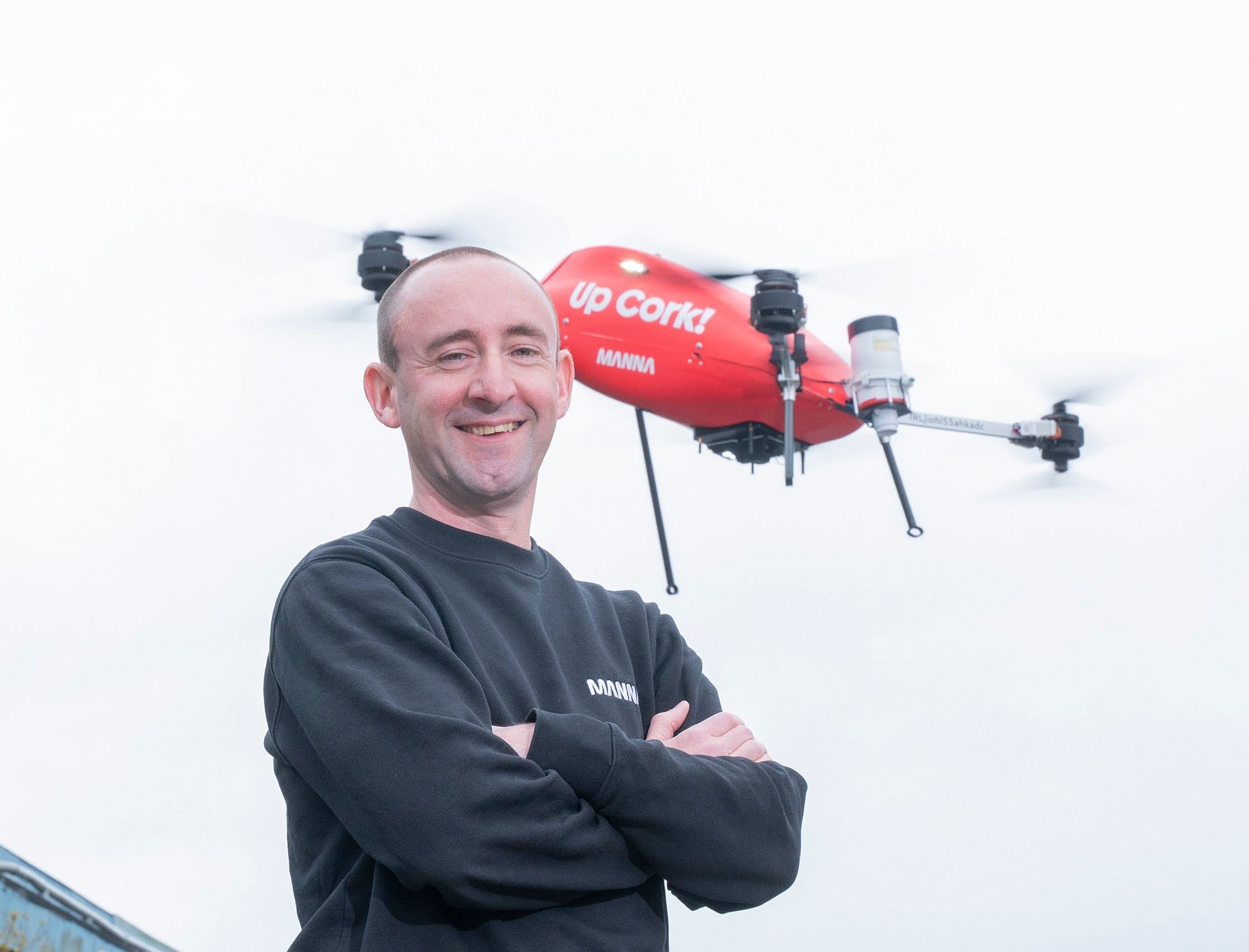
“I want to be where I can add value”
While his career path may look carefully planned, however, Huston says otherwise.
“It might look that way in retrospect, but in reality, when I see something exciting and interesting, I want to follow it; I want to be where I can add value and learn something new. That is the sweet spot for me”.
Today, in his role overseeing finance and strategy with Manna, Huston is keen to stress that it is not a “drone business.”
“We are about sustainable logistics that are safe, reliable and predictable—we are adding a new logistics layer for local commerce.
“The sky doesn’t have traffic jams, and this gives us incredible predictability. Our average delivery time is between two minutes, 40 seconds, and two minutes, 55 seconds.”
While Manna Air Delivery can transport just about anything, within certain size and weight restrictions, food is the mainstay for the business currently.
“We see food as our beachhead market because food is what people order most for delivery”, Huston says.
“Uber Eats, Just Eat, Deliveroo, Wolt and Door Dash— those guys are doing incredible numbers, close to 11 billion deliveries a year—and that’s growing at a rate of about 10 per cent annually. It’s just mind-boggling”.
The vast majority of these deliveries are by road, with safety and sustainability implications, Huston notes.
“Each of those services is relying on the category of road user most likely to be involved in collisions”, he says.
“In the UK, statistics show that one quarter of all collisions on the roads involve a last-mile delivery rider, and between seven percent and nine percent of CO2 emissions can be traced back to delivery services.”
Safer, more sustainable alternative
Huston says Manna’s air delivery service offers a safer and more sustainable alternative.
It is also a relatively easy service for consumers to use. They open their food delivery app on their smartphone and, if the restaurant uses Manna and it’s available in their area, they can simply choose this delivery option.
“From the customer’s point-of-view, there is very little difference to the standard delivery experience,” Huston says. “Our software builds a flight path from the restaurant to the customer’s home, typically their back garden. “The restaurant prepares the order, we load it onto the aircraft, the drone takes off and follows a series of waypoints 70 metres above ground at about 80 kilometres per hour.
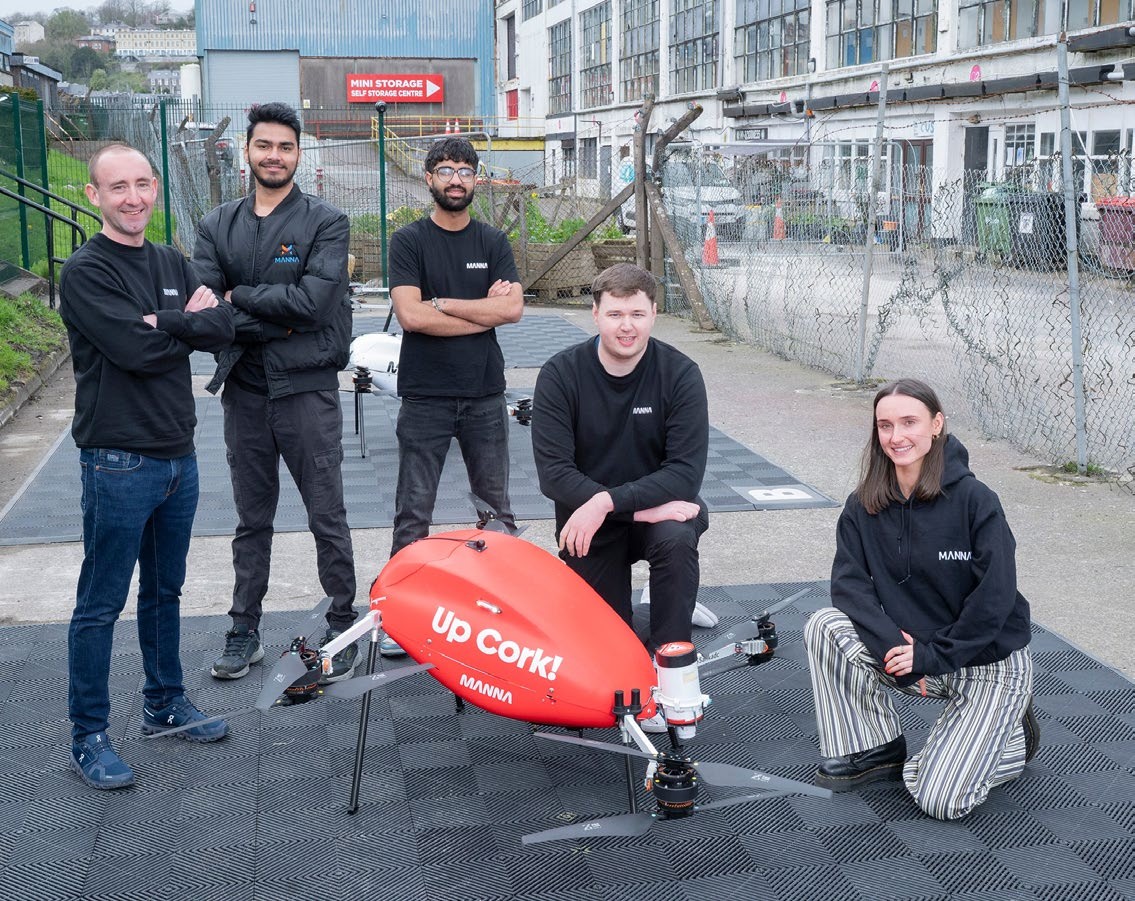
“It descends to 14 metres on arrival when the doors open and the order is lowered on a biodegradable tether the customer can then dispose of”.
On the subject of privacy, Huston continues, “a low-resolution camera is activated when the drone arrives at the delivery point.
“This allows our operator back at base to visually inspect the delivery area to ensure there are no obstacles like marquees or bouncy castles in the way. The camera stays on for a maximum of just 10 seconds”. There is a weight limit of four kilograms (kg) per order. “It’s actually 2kg per drone, but customers can order up to 4kg, and the order will be delivered by two drones flying 30 seconds apart. Ninety-eight percent of our orders are within the 2kg limit though.”
“Volume is a bit more fundamental. We can’t deliver a large pizza, for example. We can manage up to 28 centimetres square but no more”.
Accommodating larger deliveries like this would require much larger, noisier and less sustainable drones, Huston explains. Interestingly, Manna delivers quite a lot of coffee. “It’s usually not a single coffee order; it’s a few coffees for people living in the same house”, Huston says. “For coffee deliveries, in particular, Manna offers a very stable delivery system. We’re not driving along windy bumpy roads, causing spillage, and the trip isn’t long enough for the coffee to go cold”.
Global growth strategy
On foot of its latest funding round, the big focus for Manna Air Delivery now is on scaling the business in the months ahead.
“We have completed a number of operational proof points”, Huston says, “our first urban location was in Oranmore in Galway, where we demonstrated we could fly in high-wind conditions.
“We have also flown in Finland and in Texas in the US, both with temperature extremes. We have learned and iterated in real-world conditions, and shown we are able to operate in any location.
“We now want to expand to more customers in more geographies and make drone delivery part of the transport ecosystem around the world.
“I was in the US recently with other Manna executives, visiting Texas and Oklahoma. The appetite for our service over there is incredibly high.
“Our objective is to bring Manna to more customers and locations around the world. That’s what we spend our days thinking about—now it’s about scaling and execution”.
Responsible operating mandate
Of course, there are still some obstacles to overcome. “We have a responsible operating mandate”, Huston explains.
“When we go into a new area, we conduct noise surveys. In every case, we have found that the increased decibel level is minimal.
“There is a different pitch to the sound though, and we factor this into how we operate our service.
“For every adverse reaction, I would say we get 50 to 100 positive reactions. Our net promoter score with our customers is consistently in the mid-eighties or nineties”.
Where noise is an issue, the company takes steps to respond. “We can fly a bit higher which has an outsized impact on noise”, Huston says.
“In Blanchardstown in Dublin, we have rolled out lower-noise propellers. Ultimately, we want to operate in locations where customers and civic bodies share the sense of opportunity”. This opportunity extends beyond food deliveries, he adds. “Air delivery is just as attractive for retailers like bookstore owners, for example, who want to serve their local customers with fast deliveries. Using Manna, they can effectively offer a delivery experience to rival Amazon”.
Another potential use case is the delivery of prescription medicines to people with mobility or other issues that make in-pharmacy pick-ups difficult.
“This is a fantastic use case, but the reality in Ireland and most European countries is that there are security issues”, Huston says.
“The regulatory piece for prescription delivery doesn’t exist yet, but I absolutely think it will come in time. I believe Manna and services like it will be ubiquitous in a few years’ time”.
And the future for Huston himself? “I find it difficult to imagine anything else that would have the same level of interest for me as my role today with Manna”, he says, “it’s very early in our journey and there is a lot still to do”.