“What holds our founders back is not creativity, it is complexity”
EU Commissioner Michael McGrath, FCA, outlines the goals underpinning the proposed 28th Regime as a lever for entrepreneurship, growth and innovation in European business
The European Union is entering a decisive decade. We stand at a moment of profound global change: technological, geopolitical and economic.
The established ways of doing things will no longer suffice and it is indisputable that Europe needs to take urgent action to improve its competitiveness to ensure we have an economy that works for people and for business.
Competitiveness is not a “nice to have”, it is an essential condition to guarantee our prosperity, shape global standards and provide the resources we need to deliver essential public services and uphold our social contract
The new European Commission got to work immediately upon taking office on 1 December 2024 with a bold set of priorities to secure the EU’s future in a rapidly changing world.
Competitiveness compass
In January this year, we adopted the Competitiveness Compass. This is a response to the Draghi and Letta Reports calling for the EU to reduce unnecessary burdens on business and to remove barriers in the Single Market.
In fact, the International Monetary Fund has estimated that internal EU barriers are equivalent to tariffs of 44 percent for goods and 110 percent for services. This is a startling figure when you consider that the Single Market officially launched in 1993.
These costs stem from regulatory divergence, administrative duplication and inconsistent enforcement— problems the Commission is now tackling head-on.
Our message is clear: by simplifying internally, we can compete better globally. This is the essence of the EU’s drive for competitiveness and growth.
Under my portfolio as Commissioner for Democracy, Justice, the Rule of Law and Consumer Protection, I have been tasked with delivering on a series of initiatives that will strengthen the EU’s competitiveness.
The 28th Regime: business enabler
One of the most cutting-edge innovations to achieving this will be the 28th Regime, a single set of rules to help companies grow and scale across the EU.
We know that European founders generate great ideas and patents every bit as groundbreaking as those in the United States or China. What holds us back is not creativity, it is complexity.
Too often, we make it harder for innovators to grow, scale and succeed here at home. A founder should not have to navigate 27 different sets of rules on company formation, capital requirements, governance regulations or company conversions just to operate across the Single Market.
What is needed now is a seamless single market for innovators. The 28th Regime offers that missing link, a single, optional framework designed to make it easier for companies not only to set up in the EU but also scale up across the EU’s Single Market.
At the core of the 28th Regime will be a new EU-wide company legal form. We have learned lessons from previous attempts to create European company forms, and I am confident we will succeed now because the environment has fundamentally changed.
In particular, digitalisation will be central—enabling a truly frictionless, digital-first system with simpler, more flexible and faster procedures for companies to establish and grow.
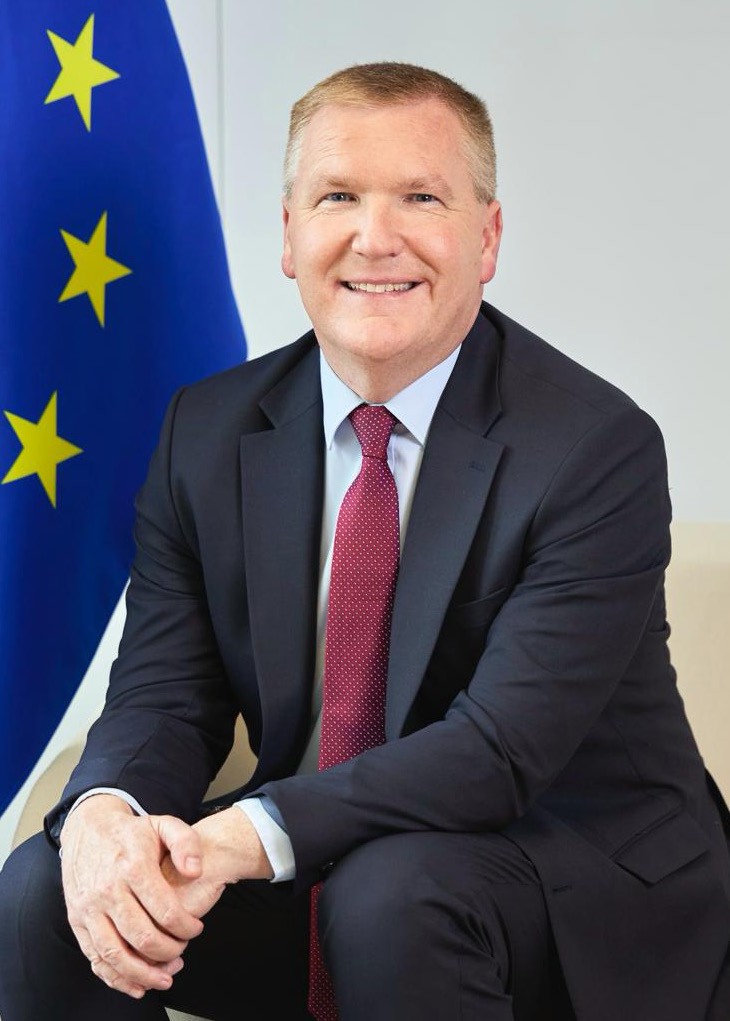
Michael McGrath is EU Commissioner for Democracy, Justice, the Rule of Law and Consumer Protection.
He has specific responsibility in the European Commission for upholding the rule of law, protecting democracy and fundamental rights, tackling disinformation, improving criminal justice cooperation and strengthening the rights of victims of crime, and improving EU competitiveness through the reform of company law and civil law.
Commissioner McGrath has lead responsibility for consumer protection policy for 450 million consumers in the EU, enforcement of the General Data Protection Regulation, and promoting trusted data flows with international partners.
For more, see here.
“AT THE CORE OF THE 28TH REGIME WILL BE A NEW EU-WIDE COMPANY LEGAL FORM. WE HAVE LEARNED LESSONS FROM PREVIOUS ATTEMPTS TO CREATE EUROPEAN COMPANY FORMS, AND I AM CONFIDENT WE WILL SUCCEED NOW BECAUSE THE ENVIRONMENT HAS FUNDAMENTALLY CHANGED”
We will build on the digital solutions already in EU company law—such as fully online company formation and the EU Company Certificate, which acts as an EU corporate ID card.
But we will also go further, creating streamlined, future-ready procedures for every stage of a company’s lifecycle, from incorporation to expansion and restructuring.
Investment and finance
In particular, we are aware that companies cannot set up and scale up without sufficient funding. Therefore, the 28th Regime will help businesses with measures to make it easier to attract investment and access various financing channels.
Instead of founders feeling they must “go to Delaware,” we want companies to be proudly “born European”. With legal certainty, digital incorporation and EU-wide recognition of status, Europe will become the easiest place in the world to start and scale a company.
As well as the company law proposal, we are looking at other important areas in which the 28th Regime can help companies compete, including taxation, labour and insolvency.
For example, we know the issuing of stock options can enable companies, particularly start-ups and scale-ups, to attract and retain skilled workers by giving employees a genuine stake in the company’s future value.
This fosters loyalty, productivity and a shared growth mindset but often this intention is frustrated by the patchwork of rules which exist across the EU, particularly in respect of tax treatment of stock options.
I am looking closely at this as part of the architecture of the 28th Regime. In addition, the outcome of the current legislative process in relation to harmonising EU rules on insolvency will be reflected in our plans.
Supporting business: additional measures
The 28th Regime will not exist in a vacuum. It will be complemented by other initiatives, such as the European Innovation Act and the European Business Wallet, both aiming to address the obstacles companies face in the Single Market.
Work is ongoing and we are making good progress. Last summer, we conducted a public consultation where we asked stakeholders to share their ideas on what they wanted to see in the 28th Regime.
The strong response to our public consultation— particularly from entrepreneurs and start-ups—shows a clear appetite for this initiative, with more than 1,500 individual replies and a further 880 responses to what we term a “call for evidence”, which is part of the stakeholder consultation process.
We were particularly pleased to receive so many replies from companies, founders and investors, many of whom had extensive experience in setting up, scaling and running a business.
These are precisely the people we need to listen to most when making the proposal for a 28th Regime.
Transformative new framework
Stakeholders have been clear: the 28th Regime must be ambitious, future-proofed and open to any business that feels it meets its needs—and this is what I intend to deliver. We aim to adopt the legislative proposal for the 28th Regime by the end of March 2026, and intensive preparatory work is now underway across the Commission and EU institutions. It is a major project—and a truly European one.
We will continue to engage with stakeholders throughout the process, and it is the prize of a truly transformative new framework that will help drive EU growth in the decades ahead that inspires every part of our work.